25-110 Analyzer Filament

This is an old tech tip that I wrote back in 2002. The 25-110 analyzer was the first CMA that Physical Electronics used a Lab6 filament in. These days there are not a lot of 590 systems still in operation, but the ones that are still work well especially as depth profile instruments. RBD provides Lab6 filaments and repair services for the venerable 590 scanning auger systems and the 25-110 analyzer.

General tips:

Use gloves.

Clean and demagnetize all of your tools.

Place all removed parts on a clean work area covered with aluminum foil.

If possible, dust off all parts with nitrogen as you re-assemble them.

Never force any part that doesn’t want to go.

Use methanol as a lubricant if screws don’t move easily.


To replace the filament in the 25-110 analyzer:

  1. Remove the magnetic shield (4 screws).
  2. Carefully remove the conical ceramic ring (4 flat-head screws) and remove the conical ceramic.
  3. Remove the outer cylinder (1 screw), being careful not to force it. If necessary, use a heat gun to loosen it up.
  4. Separate all of the wires in the bottom of the analyzer using 2 needle-nose pliers or tweezers. Be careful not to stress the wires.
  5. Position the wires so that you can easily remember where they belong. In the case of the F1 and F2 wires, this is easy. For the DELF/STIG wires, position the wires as upper right and upper left, lower right and lower left.
  6. Loosen the 4 spline set screws on the top of the inner cylinder by 1 turn CCW.
  7. Remove all but one of the 8 screws around the middle of the inner cylinder.
  8. Remove the upper inner cylinder grid cap (4 set screws).
  9. Holding on to the nose of the electron gun, remove the final screw at the middle of the inner cylinder.
  10. Carefully pull the electron gun up and out of the inner cylinder. Be careful not to stress any of the wire connectors.
  11. Place the electron gun on a sheet of aluminum foil.
  12. Loosen the bottom cap of the electron gun (4 screws and 4 set screws).
  13. Carefully slide the bottom cap down the ceramics for about 2 inches, enough room to get at the filament.
  14. Remove the filament assembly (4 cap screws, 2 splines connecting the filament wires).
  15. Install the new filament assembly and reverse all of the above steps.
  16. When you slide the electron gun ceramic tubes back down inside the analyzer be careful not to crimp the copper foil on the ceramics.  Also make sure that you tighten the set screws to hold the copper foil in place. If the copper foils slides up the ceramic it may cause arcing in the electron gun.


This slideshow requires JavaScript.

Test procedure for PHI V/F preamplifiers

Overview:

Most of the older PHI AES systems use a voltage to frequency converter (V/F) to convert the electron multiplier auger signal output from a small current into a frequency so that the computer can count the signal. At the time these systems were designed, this was a more cost effective approach than using a high resolution A/D converter.

This document explains the procedure for testing the following V/F preamplifiers:

PHI 96

PHI 96A

PHI 96B

RBD V/F-4

Equipment needed:

(1) 30meg ohm resistor (or three 10 Meg ohm resistors soldered together)

(2) Clip Leads

(1) Computer with AugerScan

(1) Oscilloscope (optional)

(1) 4 foot BNC to BNC Cable (optional)

(1) 32-100 Multiplier Supply

Note:

The V/F Preamplifiers used on PHI systems convert the current through the electron multiplier into a frequency. The maximum current is negative 500 nA. By using a 30 Meg ohm resistor (with negative 15 volts DC applied = negative 500nA) , the negative 500 nA can be applied to the collector input without the use of a DC current source, and the V/F preamplifier easily tested.

Caution! Refer servicing of electronic units to qualified personnel.

(If this procedure is followed exactly, no high voltage will be applied to the V/F preamplifier)

 Procedure:

  1. Turn the power off on the 32-100 electron multiplier supply.
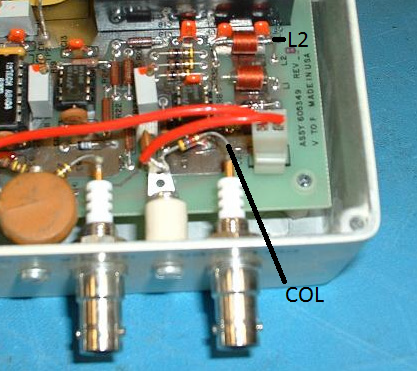
  2. IMPORTANT! Remove the HV POS IN, HV POS OUT and COL cables from the V/F preamplifier. This will prevent any high voltage from being applied to the preamplifier during testing.
  3. Set the CMA multiplier switch to OFF.
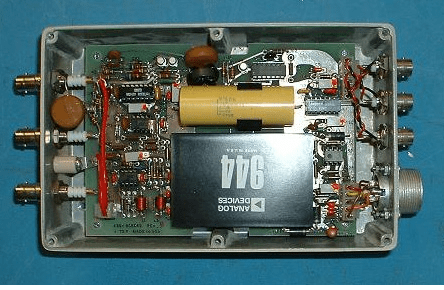
  4. Remove the cover from the V/F preamplifier:


preamplifier-96A-top-view

preamplifier-96A-top-view


  1. Locate the “Collector” (J4) connection:
preamp-j4-collector

preamp-j4-collector


  1. “Jumper” a 30 Meg ohm resistor between L2 (floating minus 15 volt supply) and the COL lead (J4):
preamp-96A-col-and-L2

preamp-96A-col-and-L2


  1. Set up AugerScan to acquire a survey in the V/F mode. Make sure that V/F 1 is selected in the hardware properties and that the Auto EMS is not checked in the multiplier properties dialog box. This will force the input into the V/F mode.
  2. Turn on the 32-100 electron multiplier supply. The CMA high voltage switch should be in the OFF position. Setting the CMA voltage switch to OFF will ensure that no high voltage will be applied to the V/F preamplifier during the test. (And the cables are also disconnected)
  3. Acquire the survey and compare the results with the table below.  If you disconnect the test resistor after the survey is about half way through then you should see the counts drop to just a few thousand CPS.


You should have approximately the following counts displayed in AugerScan: V/F preamplifier model number Maximum V/F counts per second
PHI 96 100 kHz
PHI 96A 1 mHz
PHI 96B 1 mHz
RBD V/F-4 4 mHz

 OPTIONAL – If you have an oscilloscope you can also look at the frequency output connector of the V/F preamplifier,  Just connect a BNC cable between your oscilloscope and the Frequency output connector of the V/F preamplifier.

If the frequency output is approximately the value shown in the table above, then your preamplifier is working properly. If not, RBD Instruments provides repair services and loaner V/F preamplifiers.

When finished testing, turn off the 32-100 and replace the cables to the V/F preamplifier and set the 32-100 switch to where it was before testing (typically it is set to digital).

BONUS – Here is a link to the 96A Manual, which is the most common V/F preamplifier used on older PHI AES systems.  If you have a 96B or VF4 contact RBD Instruments.


11-065 28 Volt supply Check

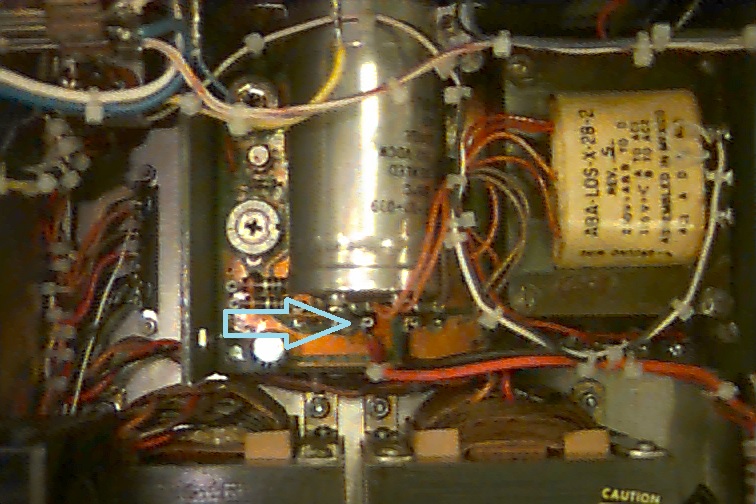
The 28 V DC power supply in the PHI 11-065 ion gun control can become weak and cause symptoms such as low emission current. To test the supply, measure the voltage from the red wire to chassis ground. It should be 28 volts to 29 volts DC, with less than 100mV AC ripple. When defective, the DC voltage will be low (about 10 to 16 volts) and there will be high AC ripple (3 to 6 volts).

Measure from the red wire post to the chassis.  CAUTION – refer servicing and testing to qualified personnel.

28-volt-supply-test-point

28-volt-supply-test-point


If your 11-065 28 volt supply is defective, RBD carries them in stock at all times. Contact us for more information.