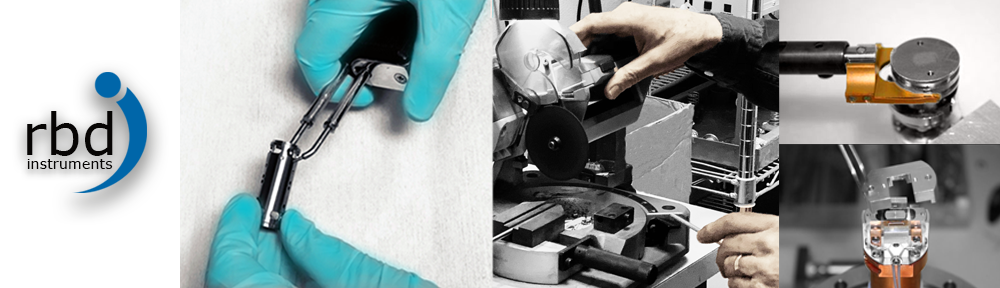
This procedure will help you to rebuild your PHI 06-660 Duoplasmatron ion source. On older ion columns the system needs to be vented before beginning this procedure. On newer ion columns there is a needle valve which allows the source to be removed and rebuilt with out venting the system. This example is the older style ion column.
For best results, read this procedure before watching the video – Duoplasmatron ion source rebuild procedure
- After venting the system, remove the gas manifold at the source. Protect the knife-edge with aluminum foil.
- Disconnect the differential pumping line. Protect the knife-edge with aluminum foil.
- Support the differential pumping port with some solid object. Use aluminum foil to protect the knife-edge from becoming damaged. The reason that this needs to be supported is so that when the alignment collars are removed from the column the bellows plate will not be supporting the total weight of the ion gun. If this happens, the bellows plate may develop a vacuum leak.
- Remove the alignment collars by first removing the screws which hold the collar to the ion gun column. Be very careful when pulling the halves of the collar away from the COND and OBJ high voltage feedthrus.
- Remove the eight ½” hex nuts, which fasten the source to the column. Be careful to support the source when you remove the last nut.
- Carefully remove the source from the column.
- Prepare a work area and cover it with clean aluminum foil. Place the source on the work area and remove the outer shield. Remove the top heat sink.
- Remove the second heat sink (3 screws) and the 6 screws, which fasten the cathode ceramic to the source housing.
- Remove the cathode ceramic by lifting it straight up. Tip: make a lip on the edge of the aluminum foil to capture the red sapphire beams which will fall out when the cathode ceramic is removed. These sapphire beads insulate the cathode from the intermediate electrode. (You can clean the nickel off of these beads with a small amount of diluted nitric acid and re-use them if you have access to a chemistry lab).
From This point on use gloves and clean tools.
- Turn the source over and remove the 4 screws, which hold the anode to the anode support housing. Use pliers to lift the anode out.
- Remove the 4 screws (also the washers and ceramics) that hold the anode support to the base of the source. Use a needle nosed pliers to lift the screws and washers out.
- Remove the ceramic at the base of the source. Use a long needle nosed pliers, being very careful not to drop the ceramic.
- Remove the 4 screws, which hold the intermediate electrode to the base of the source and lift out the intermediate electrode.
- Install the new intermediate electrode to the base of the source. Make sure it is clean. If uncertain about the cleanness of the parts, ultra-sonically clean them in methanol and then isopropanol followed by drying.
- Replace the ceramic at the base of the source.
- Set the anode support on top of the ceramic. The spring tab should line up with the electrical feedthru.
- Set the ceramics back into the anode support. Using pliers, place the washers and screws inside of the ceramics. Tighten the screws to attach the anode support to the base of the source.
- Replace the anode aperture (in the center of the anode), but punching out the old one and tapping the new one in place. The spiral-grooved side should face down (towards the anode support).
- Replace the anode; tighten the four screws, which hold it to the anode support.
- Turn the source over and set it on top of the tabletop (so that is sits flat).
- Remove the old cathode from the cathode ceramic by pulling it and turning it counter clock-wise. There is a screw in the base that should loosen up. If not, use a long Allen wrench to un-screw it.
- Install the new cathode to the cathode ceramic, using a new screw to hold it in place.
- Place a new gasket 1.33” copper gasket on the knife-edge. Slide the cathode past the copper gasket, placing the red sapphire beads into the slots as you lower the cathode. If you are having problems doing this you can drop the beads in a small amount of methanol. The capillary action will hold the beads in place while to lower the cathode.
- Tighten the cathode screws in a circular manner until the cathode is sealed.
- Replace the heat sinks and cover.
- Reverse the removal steps to place the source back on the ion gun column. Very Important: Remember to place the alignment collar ring on the source before you replace the source on the column.
END OF PROCEDURE
Additional notes:
The system MUST be baked out after working on a DP Source. The anode and intermediate are sensitive to contamination and water vapor. If not thoroughly baked out, flakes or whiskers will develop in a short period of time and the source will short out. The gas needs to be pure and there must not be any leaks in the gas line. If air mixes with the gas the source will short out after a few hours of operation. Here is a procedure on how to pump out the gas line to make sure that the gas used for the DP is pure or if you have replaced the gas bottle:
DP gas line pump out procedure
This procedure explains how to pump the air out of the gas line after replacing the gas bottle. For this procedure, the main chamber is under vacuum. If the system is up to air then you can just pump the gas line down with the rest of the chamber by first opening the piezo valve on the gas line.
- Make sure that the 20-530 and 20-520 are OFF and that the valve select on the 20-530 is set to OFF.
- Remove the side panel on the vacuum console to gain access to the gas bottle manifold.
- Close the bottle and use a large crescent wrench to unscrew the gas line from the bottle. Turn the large nut CCW to remove. Remove the gas bottle from the gas manifold.
- Make sure that the new gas bottle is tightly closed (CW).
- Put the new gas bottle in and attach the line. (Inspect the o-ring on the end of the gas line first to make sure it looks good). Firmly tighten the gas line by using a large crescent wrench to turn the nut CW.
- Keep the new gas bottle closed at this time!
- Make sure that the turbo pump is on and up to full speed.
- Pump out the intro and wait until you get 5 bars.
- Differentially pump on the ion gun. V4 should open.
- Run an extension cord from the wall to the 20-530 so that it can be powered when the ion gauge is OFF.
- Turn the card rack power off and exit Auger scan and Auger Map.
- Turn the DIGIII or DIGIV ion gauge OFF
- Turn the Boostivac ion pump control OFF
- Turn on the 20-530 and make sure the ARC current switch is OFF. Turn the gas ON, set it to 10.
- Make sure that V3 is open. If not, open it manually.
- Open V1 manually.
- Wait until the 20-530 pressure pumps down to zero. This will take up to an hour or more. If it does not drop to zero you have a leak in the gas line.
- Once the 20-530 pressure indicates zero, manually close V1 and V3.
- Turn on the ion pump control – set it to start and then run. It should start right back up.
- Turn on the DIGIII or DIGIV. The vacuum should be in the low 10-8 range and rapidly dropping into the 10-9 range. It will take a day or so to completely recover.
- Allow the turbo pump to pump on the line (V4 open) overnight.
- The next day, turn the pressure OFF on the 20-530 and turn the 20-530 OFF.
- Plug the 20-530 back into the system.
- With the 20-530 OFF and the gas valve set to OFF, open the gas bottle by turning the valve CCW. Open it slowly at first and be prepared to close it quickly if the system pressure rises. Hopefully, the valve should hold and you will not see any pressure rise. Open the valve fully CCW.
Gas bottle installation and pump down of gas line is now complete.
RBD Instruments no longer provides parts or service for the PHI DP ion guns or controllers.
This slideshow requires JavaScript.