How an electron multiplier works

This post will explain the basic concept of how an electron multiplier works.

Electron multipliers are used in surface analysis instruments to boost the detected signal to a level where it can be amplified and processed into data. For Auger Electron spectrometers and X-ray photo electron analyzers the detected signal are electrons. Secondary ion spectrometers detect ions.

In the 1960s electron multipliers were made out of a series of Oxygen treated copper beryllium (CuBe) plates.  Copper with 3 to 4% beryllium that is heat treated with oxygen has a secondary electron yield of approximately 3 (varies slightly for kinetic energies between 100 up to 1500V)

The drawing below shows the basic concept.  One electron impacts the first plate and then a few more secondary electrons are generated.  A positive voltage is applied across the multiplier array which is divided by a series of vacuum compatible resistors.  Each plate is progressively more positive and so emitted electrons are attracted to the next plate.  The resulting avalanche of electrons is attracted to the final collector plate where the signal is decoupled from the electron multiplier.  The total number of plates determines the gain of the multiplier. Most of the CuBe electron multipliers used on Auger spectrometers had a gain of 2 X 10E6discrete dynode electron multiplier gain

discrete dynode electron multiplier

When X-ray Electron spectrometers were first developed electron multipliers with higher gains were required in order to achieve better signal to noise.  During that time continuous dynode electron multipliers (Channeltrons) were developed.  Instead of a series of discrete plates, a Channeltron electron multiplier uses a high resistance semiconductor material that also has high secondary electron emissivity.  Gains of a Channeltron are typically 2 X 10E7 to 2 X 10E8. The drawing below shows the gain concept.  Many Channeltrons today are spiral instead of horn shaped to provide an even higher gain.continuous dynode electron multiplier gain

Channeltron multilplier

A third type of electron multiplier, the Micro Channel plate, was developed in order to obtain a larger detector surface area in conjunction with multi-channel detectors. Channel plates are essentially a lot of tiny Channeltron multipliers in parallel. Two plates are stacked on top of each other to increase the gain.  The drawing below shows the gain concept. Channel plate electron multipliers are commonly used on X-ray Photo electron spectrometers.MCD channel plates gain

Micro Channel plates

Electron multipliers typically last for several years with normal usage. With just occasional use they can last for decades.  Eventually the high secondary electron emissivity materials in the multiplier are depleted or the multiplier becomes contaminated and then the signal to noise degrades at which time the multiplier needs to be replaced.

Some additional reference links are listed below.   Most of these refer to ions and mass spectroscopy but it is the same principle for electron based detectors used in Auger Electron and X-ray photo electron spectrometers.

cires.colorado.edu/jimenez/CHEM-5181/Lect/MS_Detectors_AD_SNR.pdf


Electron Multipliers are available from these companies –

Photonis

Scientific Instrument Services

For assistance with installing electron multipliers or channel plates in older Physical Electronics XPS and AES surface analysis instruments contact RBD Instruments, Inc.

Reusing a Helicoflex gasket

Can you re-use a Helicoflex gasket?  The answer is yes, sometimes.

A Helicoflex gasket uses the concept of plastically deforming to seal between two flat and polished surfaces instead of the much more common knife edge seal used with copper gaskets and CF flanges.

On Physical Electronics X-ray Photoelectron spectrometers Helicoflex gaskets are used on the monochromator, the SCA (spherical capacitive analyzer) and the LS specimen stage.

Here is a link to information on how a Helicoflex gasket works –  http://technetics.com/products/sealing-solutions/metal-seals/helicoflex-delta/

First of all, Helicoflex gaskets are designed to be used only once.   However,  since these gaskets are expensive it may be worth trying to reuse it as long as you have a new gasket on hand in case the trick I will show  you in this blog post does not work.  My success rate with this trick is about 50%.  RBD Instruments provides most of the Helicoflex gaskets used on PHI XPS systems.

For this example, I will attempt to make it possible to reuse a monochromator gasket as shown in the picture below.

monochromator_gasket

mono-chromator gasket

Note that once compressed, the center surface of the gasket is flattened out.

better_view_of_flat_area

Step one is to uncompress the gasket.   To do that, find a spot on the outside edge of the gasket where you can insert a small screw driver and gently spread open the two lips of the gasket enough to get a large flat head screwdriver inside.

insert_small_screwdriver

Then, carefully work the large flat head screw driver around the perimeter of the gasket until the entire gasket is un-compressed.  Try not to deform the edges of the slit.

insert_large_screwdriver

During this process the gasket will become deformed.  Use a round surface such as a Philips screwdriver to smooth out the bumps without re-compressing the gasket.

smooth_out

Next, using a very fine emery cloth (I used some 30uM 3M sand paper) smooth out the edges of the flat surface on the gasket.  You just want to break the edges, not make it round.

break_edge_on_flat

Clean the gasket with isopropanol or methanol to remove the small particles.

clean_with_IPA

Finally, use a small amount of Apiezon L or other HV or UHV vacuum grease to the surface of the gasket (on the flat area).   You want to use a very small amount and spread it out evenly.  The vacuum grease will help to fill in any small scratches.   Wipe off the inside and outside of the gasket.   You only want a small amount on the flat area.

small_amount_of_vacuum_grease

You are now ready to install the gasket.   Good luck!

The gasket that I used in this blog post did seal fine, so I got lucky.  🙂

Homemade Titanium Sublimation Pump

In this post I show how we made a small homemade titanium sublimation pump for an 8” Kimball Physics spherical octagon UHV vacuum chamber.

Our little chamber has a 60 l/s ion pump, but even with baking (both IR and UVC), we were able to get only into the low 10-8 to high 10-9 Torr range.  However, using the little titanium sublimation pump, which we “Frankensteined” together using parts we had readily available, allowed us to get in the low 10-9 to high 10-10 Torr range, a factor of ten improvement.

A titanium sublimation pump works by heating a titanium filament wire to about 1300 degrees C. That is hot enough to create titanium gas molecules (sublimate) but not so hot that the filament wire melts.  The sublimated titanium deposits on the wall of the chamber (or preferably on a shield wall) and forms a thin film. This layer of titanium is very reactive and will bond with other molecules in the vacuum chamber such as CO and O2. Disassociated hydrogen and water vapor also diffuse into the titanium layer.

The reactivity of the titanium film is increased with lower temperatures, but most titanium sublimation pumps are operated at room temperature. Over time, the titanium film will become coated and need to be replenished. All commercial titanium sublimation pumps have 3 to 4 filaments so that when one filament burns out you can switch to another. Those filaments are also relatively thick in diameter at 12 gauge (.080”) and need about 50 amps of current to operate.

For our homemade titanium sublimation pump, we used 24 gauge (.020”) so that we could operate at a much lower current of 4 amps.  We also only have one filament.

Before I show how we made our homemade titanium sublimation pump, here are links to some videos on how TSPs work:

https://www.youtube.com/watch?v=j5Y7m2ZJfgg

https://www.youtube.com/watch?v=9vJedaxRsxI

The first thing that we needed was a 2-pin electrical feedthrough on a 2.75” CF flange.  For that we used a Getter pump flange from a PHI 04-303 ion gun as shown below.

filament_wire_connections

filament_wire_connections

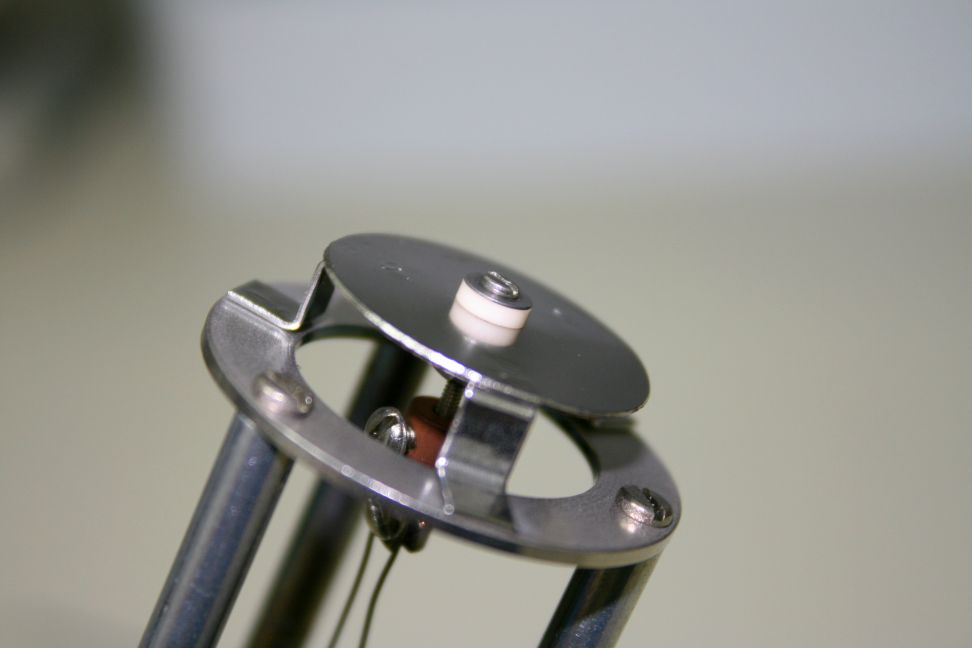
We then needed to somehow support and electrically isolate the TSP filament wire. To do that we used a coupler and some little shoulder washers.

Ceramic_support

Ceramic_support

The top part of the getter pump assembly is conveniently designed to allow gas molecules to pass through but also block direct deposition of titanium into the vacuum chamber.

blocks_direct_deposition

Next we added a few turns into the titanium wire so that it would have a little bit of a spring to it. Then we connected the wire to the flange and support assembly. We have only one filament and so by effectively doubling the length of the wire we could also double the amount of titanium that we would be sublimating.

filament_wire

filament_wire

For a chamber wall we used a 2.75” nipple that has a tube ID of 1.6” and a length of 4”.  The larger the surface area the better, but for the size chamber that we have, we are limited to a small 2.75” nipple. We mounted this nipple on our chamber horizontally so that any flakes that form will not get into the chamber or ion pump.

2.75_inch_CF_nipple

2.75_inch_CF_nipple

For a power supply, we used a 30 volt 5 amp Lavolta.

30V_5amp_power_supply

30V_5amp_power_supply

After installing our homemade titanium sublimation pump into the chamber we pumped down and were ready to operate the TSP.

To operate our titanium sublimation pump, we slowly increased the power supply current while observing the color of the light coming off the TSP filament and also monitoring the chamber pressure.  The filament needs to be orange for the titanium to sublimate. Too hot and the lifetime of the filament will be reduced. Too low and the pumping effect is reduced. By experimenting we determined that about 3.8 amps DC was the correct amount of current.  Once that was determined, we could just periodically turn the TSP on for about 2 minutes at a time.  We did that 3 times over a 6-hour period and then let the chamber pump overnight. The next morning we were in the high 10-10 Torr range.  Success!

tsp_filament_in_operation

tsp_filament_in_operation

Conclusions:

  1. It is possible to make a small titanium sublimation pump using off-the-shelf components that will operate with less than 5 amps of DC current.
  2. Adding a titanium sublimation pump to a small chamber can help to get from HV to UHV.